Which consolidation software fits your group? 7 options, honestly compared.
Multiple companies and the same struggle every month to pull the group picture together? Then consolidation software is the logical step. But the differences are large: in price, in implementation time and in what happens when your accounting package happens to lack a connection. In this article we compare 7 options for Dutch SMEs: Easyclose, Lucanet, BrightAnalytics, Finstack, Visionplanner, Speedbooks and Excel. With a comparison table, decision tree, checklist and a concrete price example at 10 entities.
| From | At 10 entities | |
|---|---|---|
| Easyclose | € 19 | € 390 |
| Speedbooks | € 50 | ± € 130 |
| Finstack | € 49 | ± € 905 |
| BrightAnalytics | quote, € 1,000 - € 5,000+ | |
| Lucanet | quote, typically € 1,000+ | |
| Excel | € 0 | your evenings |
When do you need consolidation software?
Consolidating almost always starts in Excel: a column per company, some elimination entries, a total column. That works, until it no longer does. The signals are familiar: the monthly figures are not ready until halfway through the next month, the intercompany current account balances "roughly", nobody dares change anything in the file any more, and at the financial statements reconciling the group figures takes days. Consolidation software automates exactly that work: combining entities, eliminating intragroup items, reconciling the intercompany current account per month and keeping the group picture up to date at all times.
In practice the tipping point sits at one of these three situations: three or more entities (the number of intragroup relationships grows quadratically), monthly reporting to management, bank or shareholders (a yearly Excel consolidation is too slow), or a statutory consolidation requirement (Article 2:406 of the Dutch Civil Code; read the explanation and exemptions on our page about consolidated financial statements). Below that, Excel is defensible. Above it, software pays for itself in days per month and in errors you do not make.
From days to minutes
What is a recurring project in Excel (gathering exports, pasting, eliminating, reconciling) becomes a repeatable push of a button in software. You do the set-up once.
Checks that run along
Does the intercompany current account balance per month? Is every elimination in balance? Software checks it automatically and points out the difference. In Excel you only see it when it is too late.
Substantiation for the file
The accountant or the bank wants to see where a group figure comes from. Good software clicks through from group total to entry line, with every elimination visible.
The 7 options in the spotlight
We compare the tools Dutch SME groups most often consider in practice. Up front, for clarity: we make Easyclose, so we have an interest. We therefore keep the comparison factual, also name where others are stronger, and list the prices as the vendors publish them themselves (as at July 2026; prices change, always check the current price with the vendor).
Easyclose
SME groups and accounting firmsDutch software for the month-end close, reporting and consolidation, built by a controller. The difference sits in two things. First: Easyclose connects with literally every accounting package. Directly via an API connection where available, and otherwise via the audit file (XAF) every Dutch package can export or an Excel/CSV import of all transactions, with a column profile you set once. A missing connection can therefore never block you, even if every company keeps its books somewhere else. Second, consolidation here is not a separate calculation module but part of a complete monthly cycle: a month-end close with checklist and close dashboard, then reporting with drill-down to the entry line, and the consolidation with visible eliminations and an intercompany current account check per pair of entities per month that runs over it automatically.
- Connects with every accounting package: directly via API where available, otherwise via audit file (XAF) or Excel/CSV import of all transactions
- Month-end close built in: checklist per entity, close dashboard and automatic checks before you consolidate
- Visible eliminations in the consolidation schedule and intercompany checks per pair of entities per month, with click-through to the entry line
- Dashboards you compose yourself (drag and drop), plus an AI assistant that builds dashboards, proposes mappings and explains variances
- Connect your own AI to your figures via the MCP server (Claude, ChatGPT, Copilot Studio)
- Self-service: operational within an hour, without a consultant; transparent prices (from € 29 per entity per month)
- EU hosting (Frankfurt), data isolation at database level, full export of all your data
- Not every package has a direct API connection yet; the XAF or Excel/CSV route always works then
- Advanced consolidation (currency, sub-consolidations, minority interests) sits in the Pro plan, not in Team
- Younger product than the established names; the feature set grows fast but is less broad than an enterprise suite
- Built for the Dutch market (the audit file standard and accounting conventions are Dutch)
Lucanet
corporates and large (international) groupsThe established German name in financial consolidation and planning (CPM). Functionally the most complete package in this list: statutory consolidation under multiple standards (Dutch GAAP (RJ), IFRS, HGB), extensive planning and forecasting, cash flow consolidation and a large partner network. But it is built for corporate practice: implementation runs through consultants and easily takes several months, pricing is quote-based and typically starts at thousands of euros per year plus implementation costs, and administration calls for an in-house application manager or a fixed partner. For an SME group with 3 to 15 companies that is usually too much tool for the job.
- Functionally very complete: statutory consolidation, IFRS, planning, cash flow
- Proven with large and international groups, strong partner network
- Deep audit trail and file substantiation
- Implementation through consultants: count on months and a separate implementation budget
- Quote-based pricing, typically from thousands of euros per year
- Not self-service: changes to the set-up often run through the partner
- Unnecessarily heavy in administration and costs for smaller groups
BrightAnalytics
management reporting with consolidation addedBelgian platform for management reporting with many connections and polished dashboards. Consolidation is present and usable, but the core of the product is reporting and visualisation: it shows figures beautifully and understandably for the board and management. If you mainly want a tight monthly reporting pack and want consolidation "on the side", you can do well here. If you see the consolidation itself as a core process (reconciliations, elimination substantiation, file building) you will notice the depth is thinner there. Prices are on request and move with the number of data sources and users; for a group of any size you quickly count on € 1,000 per month or more (as at July 2026).
- Very polished management reporting and dashboards
- Broad range of direct connections (including ERPs)
- Fast time to value for reporting purposes
- Reporting first: consolidation is not the deepest part of the product
- Price on request, rising with sources and users; quickly € 1,000+ per month
- No built-in month-end close process with checklist
Finstack
SME groups on mainstream cloud packagesModern Dutch consolidation tool with API connections to mainstream accounting packages and data at transaction level. Strong at pulling in figures automatically if your packages are on the connection list, with neat elimination support, dashboards you compose yourself and reporting on top. The flip side is the pricing model: the base price per entity is steep and climbs fast, and precisely the features a growing group needs are paid add-ons. At 10 entities Finstack costs € 705 per month with monthly billing; if you also want to consolidate multiple accounting packages (add-on € 35), need advanced consolidation (add-on € 35) and want working capital analysis (add-on € 13 per entity, so € 130 at 10 entities) you end up around € 905 per month (prices according to the Finstack website, as at July 2026).
- Direct API connections: figures refresh automatically, no manual export
- Data at transaction level with intercompany eliminations per counterparty
- Dashboards you compose yourself
- Modern, fast product with a short implementation time (days)
- Price climbs fast: € 705/month at 10 entities (monthly billing), heading towards € 905/month with the common add-ons
- Multi-ERP consolidation, advanced consolidation and working capital are paid add-ons rather than standard features
- Dependent on the connection list: if a company keeps its books in a package without an integration, you need a workaround
- No AI assistant, and the month-end close (checklist, closing process) is not the core; it is primarily a consolidation and reporting tool
Visionplanner
accounting firms and compilation practiceEstablished Dutch name, particularly strong in the accountancy practice: compiling, financial statements, interim figures and forecasts for firms that manage many client files. Consolidating is possible, and for firms that already work in Visionplanner it is a logical route. For a business owner or group controller who wants to consolidate and steer monthly themselves it is less obvious: the product and the pricing model are geared to the firm as the user, and the workflow revolves around the file and the financial statements more than around monthly group steering.
- Strong in the compilation practice and financial statements workflow
- Trusted by Dutch accounting firms, many connections
- Forecasts and interim figures neatly arranged
- Geared to the firm as the user, less to the business owner
- Monthly group steering and monthly intercompany reconciliation are not the core
- Pricing runs through the firm; as a business owner you often depend on your accountant
Speedbooks
reporting for firms, keenly pricedDutch reporting software that is particularly popular with bookkeeping and accounting firms: quick, neat interim reports and annual documents from the familiar accounting packages, at a keen price (at 10 entities from around € 130 per month, as at July 2026), and by now with an AI assistant. But be aware of what you are buying: virtually all the reports it produces are essentially Excel files, generated workbooks you download and send round. With that you inherit exactly the drawbacks you wanted to solve with software: no live environment where you click through to the entry, versions that start drifting around by email, and anyone who wants to change or check something is back in a spreadsheet. The consolidation is moreover simple in design: adding up and eliminating is possible, a monthly intercompany current account reconciliation or a visible elimination file is not. For a firm that produces reports a fine workhorse; for a group that wants to consolidate and steer monthly itself, too limited.
- Keen price: at 10 entities from around € 130 per month
- Connections with the mainstream Dutch accounting packages, plus an AI assistant
- Trusted by many bookkeeping firms, fast results for standard reports
- Virtually all reports are essentially Excel workbooks: no live drill-down, plenty of version misery
- Consolidation is simple in design: adding up and eliminating, little checking depth (no monthly intercompany reconciliation)
- Geared to the firm and the report, not to monthly group steering by the business owner
Excel (manual)
small groups, yearly consolidationHonesty compels us: for a holding company with one or two operating companies and a yearly consolidation, Excel is a defensible choice. It is free, endlessly flexible and everyone knows it. The problems come with scale and frequency: no automatic eliminations, no intercompany current account check, no click-through to entries, no version control. Pasting exports again every month is error-prone and dull, and a consolidation only its builder understands is a risk in itself. The same goes for Power BI: wonderful for visualisation, but it contains no consolidation logic; you have to build the eliminations and reconciliations around it yourself.
- Free and endlessly flexible
- No implementation, no vendor
- Fine for 2 entities and a yearly consolidation
- No automatic eliminations or intercompany checks: errors stay invisible
- Manual work that returns every month and grows with the group
- Person-dependent: if the builder leaves, the consolidation stalls
- No audit trail; hard to substantiate towards the accountant or the bank
The comparison table
Thirteen criteria that matter in practice, side by side. A half mark (±) means: present, but limited or only via an add-on or workaround. The table scrolls horizontally on a smaller screen.
| Criterion | Easyclose | Lucanet | BrightAnalytics | Finstack | Visionplanner | Speedbooks | Excel |
|---|---|---|---|---|---|---|---|
| Target group | SME group & firm | corporate | SME & midcorp | SME group | firm | firm | everyone |
| Works with every accounting package | Yes, always | ± via partner | ± connection list | ± connection list | ± connection list | ± connection list | Yes |
| Direct API connection | Yes, where available | Yes | Yes | Yes | Yes | Yes | No |
| Implementation time | ± 1 hour, yourself | months | days-weeks | days | via firm | days | immediate |
| Fully self-service | Yes | No | ± | Yes | No | ± | Yes |
| Month-end close with checklist | Yes, built in | ± workflow | No | No | ± file | No | No |
| Visible eliminations | Yes | Yes | ± | Yes | ± | ± | ± build yourself |
| Monthly intercompany check | Yes, per pair | Yes | ± | Yes | No | No | No |
| Drill-down to entry line | Yes | Yes | ± | Yes | ± | No, Excel report | No |
| Build dashboards yourself + AI assistant | Yes, both | ± via partner | Yes, dashboards | Yes, dashboards | No | ± AI assistant | ± manual work |
| Connect your own AI (MCP) | Yes | No | No | No | No | No | No |
| EU data location + full export | Yes, standard | EU/choice | EU | EU | EU | EU | local |
| Price at 10 entities (per month) | € 290 - € 390 | quote, € 1,000+ | quickly € 1,000+ | € 705 - ± € 905 | via firm | from ± € 130 | € 0 + hours |
As at July 2026, based on public information from the vendors; prices and features change, always check the current situation with the vendor itself. Easyclose: Team € 29 and Pro € 39 per entity per month, without add-ons for these features; direct API connections where available, otherwise always via audit file (XAF) or Excel/CSV import of all transactions. Finstack: € 705 per month at 10 entities and monthly billing; with the add-ons multi-ERP consolidation (€ 35), advanced consolidation (€ 35) and working capital (€ 13 per entity) the total comes to around € 905. Speedbooks: at 10 entities from around € 130 per month; the reports are essentially Excel workbooks.
Which one fits you? Four questions
You do not have to try all seven. In most cases these four questions bring you to the right shortlist.
Do you have only one company?
Then you do not need consolidation software. If you do want better dashboards and analyses than your accounting package offers, look at a reporting tool (or Easyclose Basic, € 19 per month).
→ No consolidation neededMultiple companies, everything in Excel today, and you want to be at the wheel yourself?
Then you are looking for self-service software with a low threshold and an honest price. Compare Easyclose and Finstack: look at the total price including add-ons, at what happens when one company keeps its books in a package without a connection, and at whether you also want a month-end close process rather than consolidation alone.
→ Easyclose or Finstack (recalculate the total price)Large or international group, IFRS, multiple standards, your own consolidation team?
Then you are in the enterprise class and the implementation investment can be justified. Lucanet is the logical candidate there, with BrightAnalytics as a lighter alternative when reporting weighs more heavily than statutory consolidation.
→ Lucanet (or BrightAnalytics)Are you an accounting or bookkeeping firm?
Then the workflow across many clients is what counts. Visionplanner and Speedbooks are the established firm tools; Easyclose has a firm licence with unlimited entities and users per client, interesting if you serve clients with group structures and the monthly figures matter more than just the annual documents.
→ Visionplanner, Speedbooks or Easyclose for firms
Price example: a group with 10 entities
Comparing price lists is hard because every vendor counts differently: per entity, per user, per connection, with or without add-ons. So here is one concrete example: a Dutch group with 10 entities that wants to consolidate monthly, including intercompany current account checks and working capital insight, with monthly billing (as at July 2026). From cheap to expensive the ladder looks like this; above all, note what you get for the amount.
Free, but manual work
- No licence costs, but hours of pasting work every month
- No automatic eliminations or intercompany checks: errors stay invisible
Cheap, but Excel reports
- Keenest entry for standard reports
- Reports are essentially Excel workbooks: no live drill-down, plenty of versions
- Consolidation simple, no monthly intercompany reconciliation
Everything for the monthly cycle
- Consolidation, visible eliminations and intercompany checks included
- Month-end close with checklist and close dashboard included
- Dashboards, drill-down, reporting and export included
Plus advanced consolidation
- Everything from Team
- Advanced consolidation (currency, sub-consolidations, minority interests) included
- Working capital steering and forecasting included, unlimited users
Modern, but with add-ons
- Base platform at 10 entities, monthly billing
- Add-ons for multi-ERP consolidation (€ 35), advanced consolidation (€ 35) and working capital (€ 13 per entity)
- Comparably complete you end up around ± € 905
The top of the market
- Quote or request basis, rising with size and sources
- With Lucanet, implementation costs and a partner project come on top
The lesson of the ladder: do not look only at the amount, but at what is in it. At the bottom you pay with hours, error risk or reports that are really just Excel. At the top you pay for add-ons, implementation projects or enterprise features an SME group rarely needs. The middle segment, everything for the monthly cycle at one transparent price, is the logical place for most groups of 3 to 15 entities. Recalculate for your own number of entities with the price calculator.
Where Easyclose makes the difference
We build Easyclose from one conviction: consolidating should not be a project but a by-product of a good monthly cycle. That is why there is more around it than just the calculation core.
Never wait for a connection
Directly via API where available, and otherwise via the audit file (XAF) or an Excel/CSV import of all transactions with a reusable column profile: every entity joins in, from whichever package. Every company in a different package? No problem, and no add-on.
Close first, then consolidate
The month-end close with checklist and close dashboard ensures the underlying figures are fixed before you consolidate. No group report on figures that are still moving.
An intercompany check that points out differences
Per pair of entities and per month, both sides of the intercompany current account are reconciled. A difference gets month and amount attached, with click-through to the entries.
An assistant plus your own AI
The built-in assistant builds dashboards on request, proposes the account mapping and explains variances. Via the MCP server you can also connect your own AI (Claude, ChatGPT, Copilot Studio) safely to your figures.
Within an hour, without a consultant
Create an account, import, drag accounts to categories, record the group structure: everything self-service. The demo shows you exactly what you get beforehand.
One price, no add-on maze
€ 29 or € 39 per entity per month, and it is all in there: consolidation, intercompany check, month-end close, dashboards, export. EU hosting and a full data export, so you are never locked in.
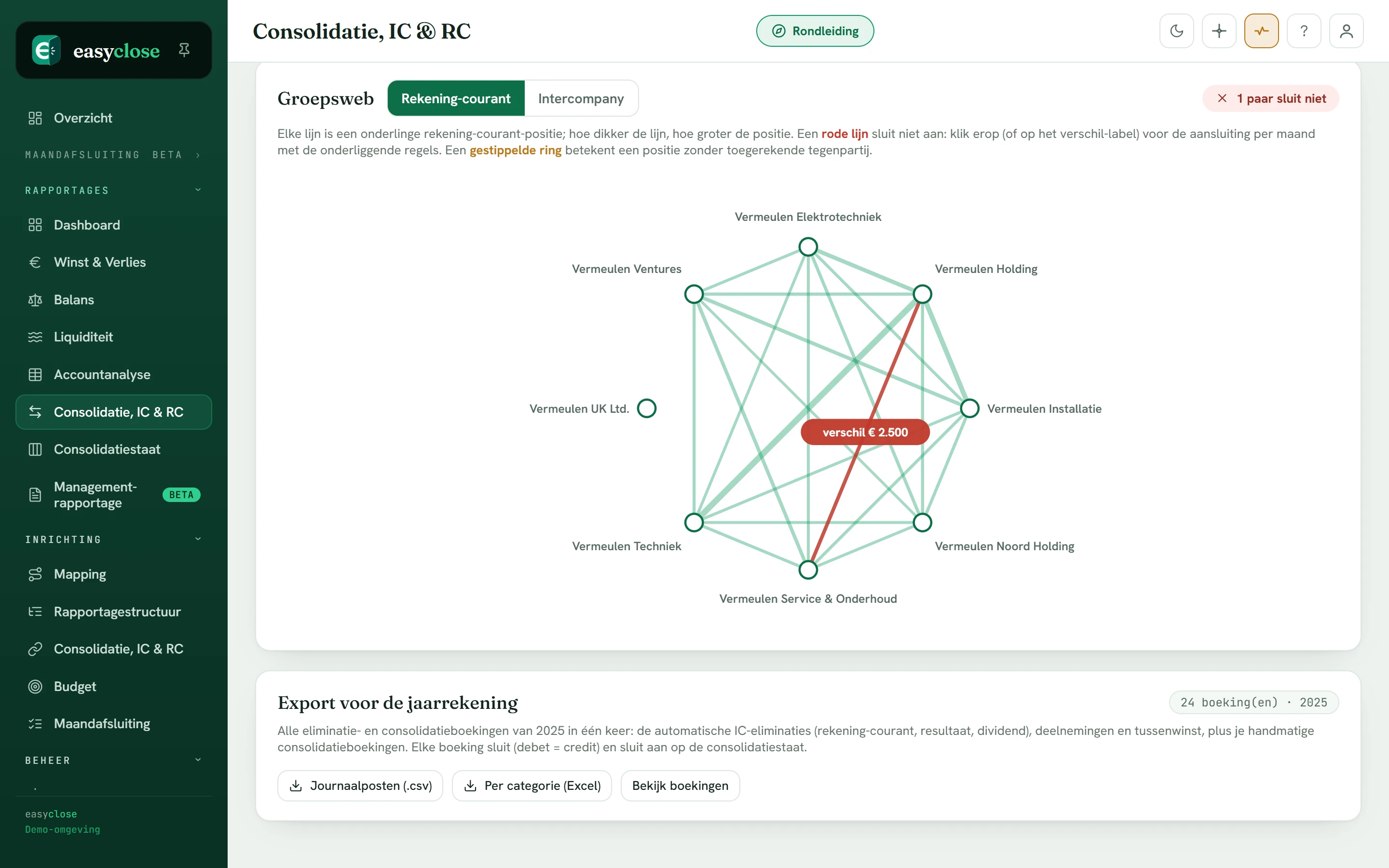
The intercompany check that points out the difference
This is the real group web from the demo: the red line is an intercompany current account that does not balance, with the difference next to it. One click opens the reconciliation per month.
See it in the demo →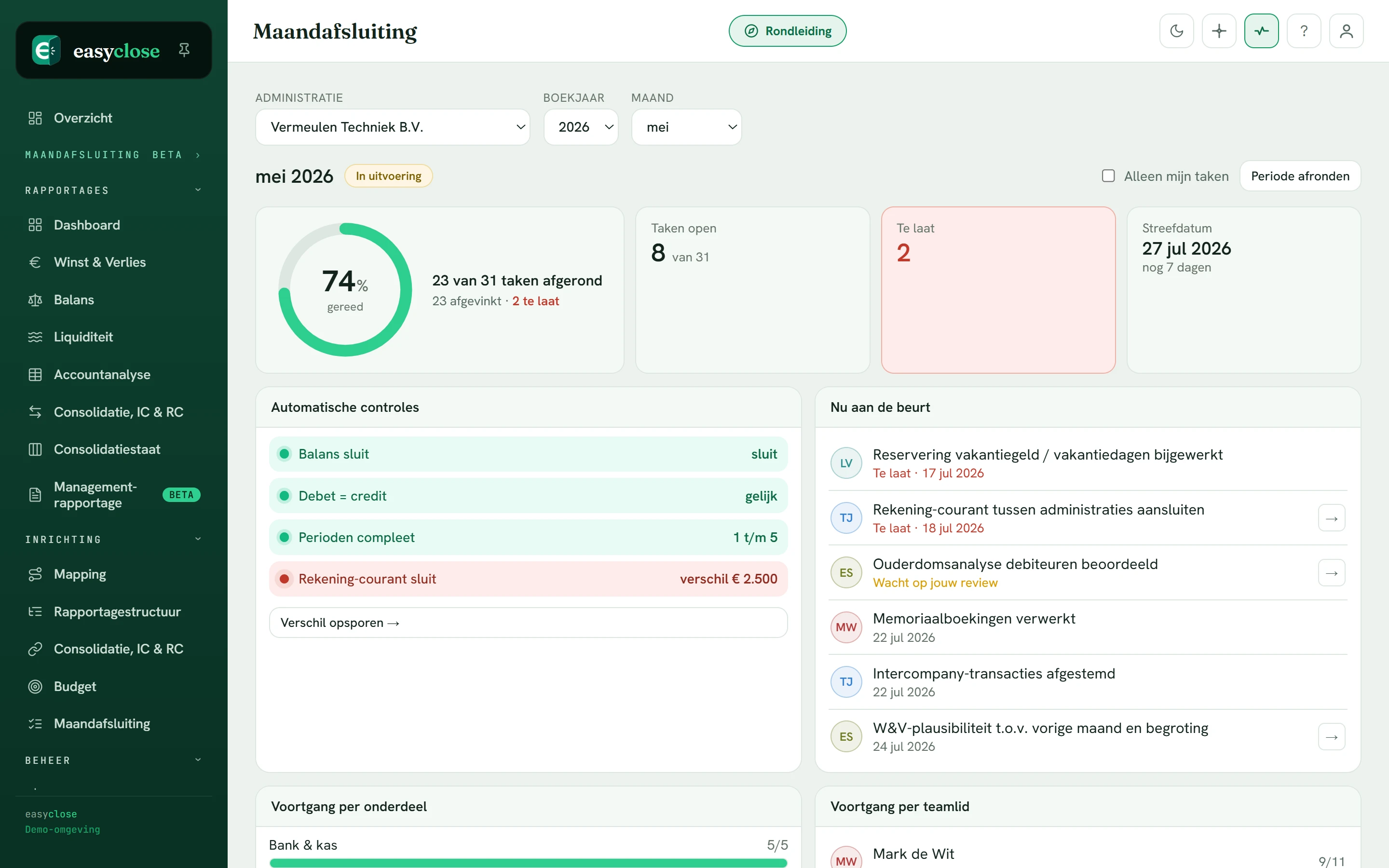
The month-end close before the consolidation
Checklist per entity, progress at a glance and automatic checks. Only when the month is closed does the group report go out the door.
See it in the demo →Checklist: 7 requirements for good consolidation software
Whichever tool you are considering, hold it against these seven requirements. They come straight from the practice of controllers who moved from Excel to software.
- All your entities join in, regardless of the accounting package. Ask explicitly what happens if one company keeps its books in a package without a connection. "That one cannot join in" is not an acceptable answer.
- Eliminations are visible and traceable. A consolidation schedule with a real elimination column, and every elimination traceable to the underlying entries. No black box.
- The intercompany current account balances per pair of entities and per month. An intercompany account only checked at year total hides errors that cancel each other out. The software must point out the difference, with month and amount.
- Drill-down to the entry line. From consolidated group figure to the individual entry in a few clicks. For yourself, for the accountant and for the bank.
- You can set it up and change it yourself. A new company added, a category moved, a mapping changed: if that requires a consultant, you pay twice.
- The total price is predictable. Recalculate it for your number of entities, including all the add-ons you need, with monthly billing. Compare total prices, not entry prices.
- Your data is safe and yours. EU data location, isolation between organisations at database level, and a full export of all your data so you can always leave. Ask about it; the answer says a lot.
Three common mistakes when choosing
Most disappointments after a software choice trace back to one of these three.
Choosing on demo shine
Pretty dashboards sell, but the value sits in the reconciliation: does the intercompany account balance, are the eliminations right, can you click through to the entry? In a trial period, always test with your own figures and your own trickiest entity, not with the vendor's sample data.
Comparing the entry price instead of the total price
"From" prices say little. Recalculate for your number of entities, with all the add-ons you actually need (multi-ERP, advanced consolidation, working capital, extra users) and with monthly billing. The difference between entry price and total price can be hundreds of euros per month.
Underestimating the implementation
Software that takes months to implement has to earn that investment back over years. Ask who does the set-up (you or a consultant), what a later change costs, and how quickly a new entity is added. Self-service is not only cheaper; it keeps the knowledge in-house.
Method and sources
This comparison was written by the team behind Easyclose, with the eye of a controller who ran the monthly cycle himself for years. We would rather name that interest out loud than hide it: read critically and verify everything that matters to your choice. This is how we went about it:
Public information, checked ourselves
The features and prices of the other packages come from their public websites, pricing pages, product documentation and demo or trial environments. Their current offering is on their own sites, and that is also the place to verify our summary.
July 2026, monthly billing
All amounts are per month and excluding VAT, with monthly billing, for an example group of 10 entities. Prices and feature lists change; we refresh this article periodically, but the current price always sits with the vendor itself.
No paid mentions
No party in this article paid for a mention or a position. The Easyclose figures are traceable to our own pricing page; the judgement on the rest is that of a controller who scoured the market before we started building ourselves.
The legal framework around the Dutch consolidation requirement and the exemptions (Articles 2:406, 2:407 and 2:408 of the Dutch Civil Code) can be read in Book 2 of the Dutch Civil Code on wetten.overheid.nl (in Dutch); a plain-language explanation is on our page about consolidated financial statements. More background on the parts of this comparison is on our pages about the month-end close, financial reporting, consolidation in action and security and data location, and in the price calculator. And the best source remains your own practice: the demo is open to everyone, without an account.
Frequently asked questions about consolidation software
What is consolidation software?
Consolidation software automatically combines the accounts of multiple entities (for example a holding company with operating companies) into one group picture. The software eliminates intragroup positions and transactions (intercompany current accounts, management fees, intragroup deliveries), checks whether the intragroup balances match on both sides and delivers the consolidated profit and loss account and balance sheet. Good consolidation software makes every elimination visible and traceable to the underlying entries.
When do I need consolidation software?
As soon as you have multiple companies and want to see the group picture more than once a year. In practice the tipping point is often three or more entities, monthly reporting to management or the bank, or an intercompany current account that can no longer be reconciled by hand. A statutory consolidation requirement (Article 2:406 of the Dutch Civil Code) can also be the trigger, although many SME groups consolidate voluntarily because the bank or the board asks for group figures.
What does consolidation software cost?
The differences are large; take a group of 10 entities as an example (as at July 2026). At the bottom sit reporting tools such as Speedbooks (from around € 130 per month, but the reports are essentially Excel files). In the middle segment you pay Easyclose € 290 per month (Team) up to at most € 390 per month (Pro, including advanced consolidation and working capital). Above that sits Finstack at € 705 per month with monthly billing, heading towards € 905 with the common add-ons, and BrightAnalytics and Lucanet play in the class of € 1,000 per month or more, often plus implementation costs. Excel is free, but the hidden costs sit in the hours and the errors.
Can I also consolidate in Excel?
It is possible, and many groups do it. But Excel has no automatic eliminations, no intercompany current account check per month and no click-through to the underlying entries. One changed export or one forgotten elimination and the group picture is wrong, without warning. Excel remains fine for a one-off or very small consolidation; as soon as you consolidate monthly or the group grows, software wins on both speed and reliability.
How long does implementing consolidation software take?
That ranges from an hour to months. Self-service software such as Easyclose you set up yourself: import the entities, drag accounts to categories and record the group structure, usually within an hour to half a day. Modern cloud tools with API connections sit at days to weeks. Enterprise suites such as Lucanet are implemented through consultants and easily take several months plus an implementation budget.
Does my accounting package need a connection with the consolidation software?
With most tools, yes: no connection means not joining in, or waiting until the vendor builds the integration. Easyclose connects with every accounting package: directly via an API connection where available, and otherwise via the audit file (XAF) every Dutch package can export or an Excel/CSV import of all transactions, with a column profile you set once. That way every entity joins in, even if every company keeps its books in a different package, and a missing connection can never block you.
Is consolidation software safe for my financial data?
When choosing, look at three things: where the data is stored (EU data location in view of the GDPR), how organisations are separated from each other (preferably enforced at database level, not only in the application) and whether you can always export your data as a whole so you are never locked in to the vendor. Easyclose hosts encrypted within the EU (Frankfurt), separates organisations at database level and has a full data export as a standard feature. Read more on our security page.
Test it with your own group, this week
The best comparison is your own practice. Open the demo with the fictitious Vermeulen Group (holding company, intermediate holding, operating companies, minority participating interest and a foreign subsidiary), or create a free environment and import your own accounts. Within an hour you see your own group figures, including the intercompany current account check.
- Connects with every accounting package: API, audit file (XAF) or Excel/CSV
- Consolidation with visible eliminations and a monthly intercompany check
- Month-end close with checklist and close dashboard included
- Build your own dashboards, with an AI assistant that builds along
- € 29 to € 39 per entity per month, without an add-on maze
- EU hosting, data isolation at database level, full export