Consolidated financial statements, from obligation to practice.
Multiple companies means consolidating sooner or later: combining the group's figures into one picture, eliminating everything that happens within the group. On this page you will read what consolidated financial statements are, when the Dutch consolidation requirement (consolidatieplicht) applies and which exemptions exist, how to consolidate in seven steps, and where it goes wrong in practice.
| Holding | OpCo | Elimination | Group | |
|---|---|---|---|---|
| Revenue | 135,500 | 4,310,000 | -135,500 | 4,310,000 |
| Costs | -52,300 | -2,147,700 | 135,500 | -2,064,500 |
| Result | 83,200 | 2,162,300 | 0 | 2,245,500 |
What are consolidated financial statements?
Consolidated financial statements show a group of companies as one economic entity. When consolidating, you combine the figures of all group companies (for example a holding company with its operating companies) line by line, and then take out everything that happens within the group: intragroup receivables and payables, management fees, recharges, intragroup deliveries and the participating interests themselves. What remains is what the group as a whole has done with the outside world.
That combining is not a simple sum. Without eliminations you count revenue twice (the holding company's management fee is a cost at the operating company), receivables and payables sit on the balance sheet that cancel out within the group, and there is profit in stock that the group has not actually made yet. The core of consolidating is therefore eliminating, and the core of consolidating well is that those eliminations are traceable.
The group as one business
The board, the bank and the shareholders want the picture of the group, not six separate trial balances. The consolidated figures are the basis for steering and financing.
Intragroup items out
Intercompany current accounts, intragroup fees and deliveries, capital interests and intercompany profit on stock are eliminated. Only transactions with the outside world remain.
Correct and substantiated
A consolidation is only finished when the intercompany current account between the entities balances and every elimination can be substantiated, for the file and for the accountant.
When are you required to consolidate?
The Dutch consolidation requirement (consolidatieplicht) is set out in Article 2:406 of the Dutch Civil Code, part of the accounting rules in Book 2 Title 9: the legal entity that heads a group includes consolidated financial statements in the notes to its own financial statements. A group arises quickly: as soon as a holding company controls one or more operating companies and they are organisationally connected. But the main rule has two important exemptions, and in the SME segment those often make the difference.
The group head consolidates
If you head a group, your financial statements must include consolidated financial statements of the whole group, including every subsidiary you control.
The small group
If the group jointly qualifies as small, the consolidation requirement lapses. Since financial year 2024: a balance sheet total up to € 7.5 million, net revenue up to € 15 million, fewer than 50 employees. Two of the three criteria, on two consecutive balance sheet dates.
The intermediate holding
An intermediate holding company does not have to consolidate itself if its figures are already included in the consolidated financial statements of a higher parent company that meets the conditions.
Note the difference with the 403 declaration (Article 2:403 of the Dutch Civil Code): that exempts a subsidiary from publishing its own full financial statements, in exchange for the parent accepting joint and several liability, and actually presupposes that consolidation does take place. It is therefore not an exemption from the consolidation requirement. And even without a statutory obligation, many groups simply consolidate anyway: because the bank asks for group figures, or because without a consolidated picture you simply do not know how the group is doing. Unsure about your own situation? Put it to your accountant, the details matter.
Consolidating in 7 steps
Whether you consolidate yearly for the financial statements or monthly for steering, the process follows the same steps. The order below works from structure to detail: first get the group and the reconciliations in order, only then eliminate and report.
Record the group structure
Who is the group head, which companies sit underneath it, with what stake, and which method fits: full, proportionate or the equity method. This determines how each entity counts.
Align the charts of accounts
Every company has its own general ledger. Map all accounts to one shared category structure, so revenue, costs and balance sheet items mean the same thing everywhere.
Reconcile the intragroup positions
Check per pair of entities whether the intercompany current account and intragroup loans match on both sides, preferably per month. A difference here carries through into everything that follows.
Eliminate the intragroup transactions
Management fees, recharges, intragroup deliveries and interest: what one group company invoices to another comes out of revenue and out of costs.
Eliminate the capital interests
The participating interest on the parent's balance sheet cancels out against the subsidiary's equity. With a stake below 100% you determine the share of third parties: the minority interest.
Handle the special items
Intercompany profit on stock the group has not yet realised, foreign subsidiaries that translate at the right exchange rates, and participating interests under the equity method.
Prepare the consolidation schedule and substantiate it
A column per entity, the eliminations visible next to it, and then the consolidated picture. Every elimination must be traceable to the underlying entries, for the file and the accountant.
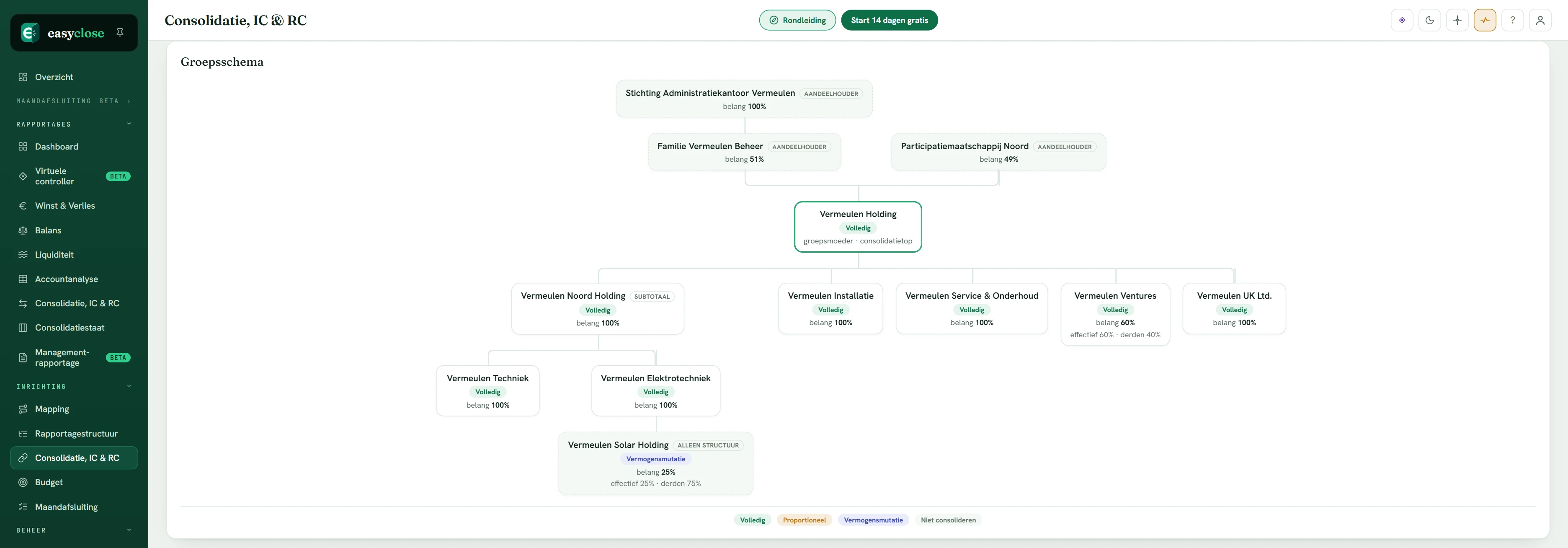
Step 1, the group in one screen
This is the real group chart from the demo: holding company, intermediate holding, operating companies and participating interests, with per entity the stake and the method. From here the consolidation runs along by itself.
See it in the demo →The classic pitfalls when consolidating
Most consolidation errors are not arithmetic errors, but things that quietly go wrong and only surface at the financial statements (or worse: at the bank). These are the three we see most often.
The intercompany account only balances in total
An intercompany current account that ends the year at zero can be well off per month: two opposite errors cancel each other out. Whoever only checks the total never sees it. Reconcile per pair of entities and per month.
Invisible eliminations
If eliminations sit in a formula or a hidden tab, nobody can check them, including you three months from now. Every elimination should be visible and substantiated.
Intercompany profit and currency
Profit on intragroup deliveries still sitting in stock, and exchange differences at a foreign subsidiary: exactly the items that fall through first in a manual consolidation.
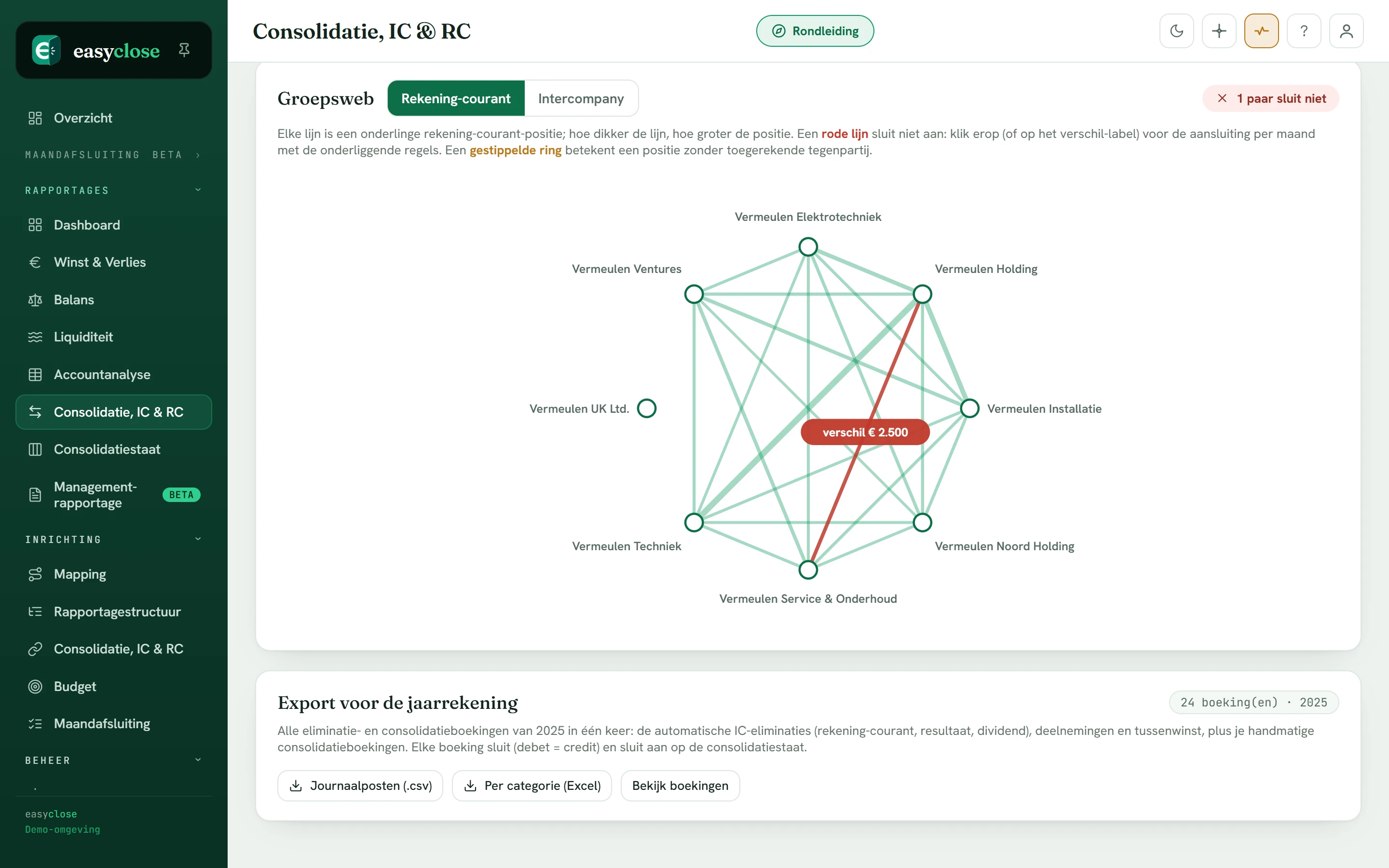
The intercompany check that points out the difference
This is the real group web from the demo: the red line is an intercompany current account that does not balance, with the difference next to it. One click opens the reconciliation per month. Exactly the false green pitfall, but caught.
See it in the demo →Consolidation software or Excel after all?
Many groups consolidate in Excel: a column per company, manual elimination entries and a total column. That works, until the group grows or someone else touches the file. One changed export, one forgotten elimination or one overwritten formula and the picture is wrong, without warning. Consolidation software solves exactly that: the combining is automatic and repeatable, the checks run along and every step remains traceable.
The same push of a button every month
You set up the structure and the mapping once. After that, every new month or year is the same consolidation, without copying work and without versions.
The intercompany check runs automatically
Per pair of entities and per month the intercompany current account is reconciled. A difference is pointed out immediately, with month and amount, instead of at the financial statements.
From group figure to entry line
Every elimination sits visibly in the consolidation schedule and clicks through to the underlying entries. Exactly what you need for the file and the accountant.
Comparing options? In the article the best consolidation software for SMEs we put 7 options side by side, from Excel to enterprise, with a comparison table, decision tree and a concrete price example at 10 entities.
How Easyclose makes consolidating easy
Easyclose is Dutch software for reporting and consolidation, built by a controller. You import the accounts of your companies from every accounting package, record the group structure once and from that moment the consolidation runs along automatically, with visible eliminations and an intercompany current account check per month. Operational within an hour, without a consultant.
The group in one screen
Holding company, intermediate holdings, operating companies and participating interests with their stakes, as an org chart. Per entity full, proportionate or the equity method, with the minority interest calculated automatically.
Visible, not hidden
The consolidation schedule shows a column per entity, a real elimination column and the consolidated picture. Every elimination balances and clicks through to the entry line.
Differences with month and amount
The reconciliation matrix compares both sides of the intercompany current account per pair of entities and per month, and points out a missing matching entry exactly.
The tricky items too
Intercompany profit in stock, foreign subsidiaries with currency translation, participating interests under the equity method and manual consolidation entries with an export for the financial statements.
Connects with every package
Every company can come from a different accounting package: directly via API where available, and otherwise via the audit file (XAF) or an Excel/CSV import of all transactions, with a column profile you set once.
EU hosting, strictly separated
Your data is stored encrypted within the EU (AWS Frankfurt). Every organisation sees only its own figures, enforced at database level.
Want to see what that looks like in practice? On the page consolidation in action you see the group structure, the visible eliminations and the intercompany check move step by step. Or read on about financial reporting and the month-end close a good consolidation builds on.
Frequently asked questions about consolidated financial statements
What are consolidated financial statements?
Consolidated financial statements present a group of companies (for example a holding company with operating companies) as one economic entity. The figures of all group companies are combined line by line, after which intragroup positions and transactions (intercompany current accounts, intragroup deliveries, management fees, intercompany profit on stock) are eliminated. What remains is the picture of the group as if it were a single company: the consolidated balance sheet and profit and loss account.
When am I required to consolidate?
The main rule is in Article 2:406 of the Dutch Civil Code (artikel 2:406 BW): the legal entity that heads a group must include consolidated financial statements in the notes to its own financial statements. There are two important exemptions: the small group (Article 2:407(2), where the group as a whole meets the criteria of the small company regime) and the intermediate holding company (Article 2:408, where the figures are already included in the consolidated financial statements of a higher parent company). Always put your specific situation to your accountant, because the details matter.
When does the small group exemption apply?
A group head does not have to consolidate if the group jointly qualifies as small. Since financial year 2024, raised thresholds apply: a balance sheet total up to € 7.5 million, net revenue up to € 15 million and fewer than 50 employees. If the group meets at least two of these three criteria on two consecutive balance sheet dates, the small company regime applies and the statutory consolidation requirement lapses. Many groups still consolidate voluntarily, because the bank asks for it or because management wants to steer at group level.
Is a 403 declaration the same as a consolidation exemption?
No, it is almost the opposite. A 403 declaration (Article 2:403 of the Dutch Civil Code) exempts a subsidiary from preparing and publishing its own full financial statements, on the condition that the parent accepts joint and several liability for the subsidiary's debts and the subsidiary's figures are included in consolidated financial statements. A 403 declaration therefore presupposes that consolidation takes place; it is not an exemption from the consolidation requirement.
Which consolidation methods are there?
There are three common methods. Full consolidation: the figures of a subsidiary you control count in full, and with a stake below 100% the share of third parties is shown separately as a minority interest. Proportionate consolidation: with a joint venture, for example, you include the figures in proportion to your stake. Equity method: a participating interest without controlling influence is not consolidated but valued at net asset value, with your share of the result increasing the carrying amount.
What is eliminated in a consolidation?
Everything that happens within the group: intragroup receivables and payables (intercompany current accounts, intragroup loans), intragroup transactions (management fees, recharges, intragroup deliveries, interest), the parent's capital interest in the subsidiary against that subsidiary's equity, and unrealised intercompany profit on stock delivered from one group company to another. After the eliminations, only what the group has done with the outside world remains.
Can I consolidate in Excel?
It is possible, and many groups do it that way, but it is error-prone. Columns per company, manual elimination entries and an intercompany current account that is only reconciled at total level: one changed export or one forgotten elimination and the picture is wrong, without you seeing it. Consolidation software such as Easyclose combines the entities automatically, shows every elimination visibly in the consolidation schedule and checks the intercompany current account per pair of entities and per month.
See your own group consolidated, this week
Open the demo with the fictitious Vermeulen Group (holding company, intermediate holding, operating companies, minority participating interest and a foreign subsidiary), or create a free environment and import your own accounts. You record the structure yourself, the consolidation runs along by itself.
- Group structure with stakes and methods in one screen
- Visible, verifiable intercompany eliminations
- Intercompany check that points out both the month and the amount of a difference
- Minority interest, participating interests, currency and intercompany profit
- Every company in a different accounting package? No problem
- EU hosting, strictly separated data, operational within an hour